

We Are Not Outside.
On sentient shrubs, carbon cycles, the growing stack of good books on my desk, and an invitation to gather at The Seasonal Table this spring.

I’m writing a new book proposal, which means I’m reading everything right now.
Ecology. Botany. Biology. Carbon. Fungi. Roots. Light.
The deeper I go, the less certain I am that I really understand what’s happening outside.
We’ve been told nature is a collection of parts. Organisms. Systems. Inputs and outputs that operate more like a mathematical equation than a Garden of Eden.
But what if it’s closer to a conversation? Full of biological polyglots speaking so many languages that you wonder how Mother Nature hears them all.
Paul Hawken, in his fantastic book Carbon, says it’s more like a symphony. A billion exchanges at once, all on key and in perfect time. Carbon moving through soil, leaf, lung, ocean, stone. Nothing wasted. Nothing alone. Plants and animals and fungi, all in constant response. Constant consciousness.
It’s difficult territory.
I understand that for some people, the idea of plant or animal consciousness is a bridge too far. Some look for the unsubscribe button. Others start drafting constitutional amendments for shrubs.
I don’t see it as either extreme.
Consciousness doesn’t stop me from eating salad.
It doesn’t make me tiptoe around ants.
But it does change how I stand in the yard.
It reminds me that I’m not observing a natural world.
I’m participating in one.
Reciprocity
We’ve forgotten our manners. The ecosystem was never meant to be an ATM.
Every breath I take contains oxygen released by plants. Every breath I exhale returns carbon dioxide.
Gift for gift.
Carbon cycles. Water ebbs and flows. Energy is borrowed, rearranged, returned.
We are not outside this exchange. We are a temporary expression of it. Oh so temporary.
And yet modern life sometimes feels like a divorce from that awareness.
The digital world offers connection without warmth. Information without pulse. Pixels without squishiness.
We scroll in solitude and call it community.
There is no feedback. Why are we always taking?
The Indoor Life
We have insulated ourselves from the very systems that animate us.
We sanitize until sterile.
Replace leaves with plastic.
Flames with LEDs.
Sunlight with supplements.
We move electrons all day.
Not our bodies.
It feels efficient.
It also feels incomplete.
The other afternoon I checked my phone: 1,800 steps all day. Most between my desk and the refrigerator. I hadn’t been outdoors in 18 hours.
No sun on my skin.
No bird song.
No exchange of breath with a tree.
There is research suggesting that five-minute breaks every half hour lowers stress. I suspect those five minutes would be even better outside.
A primal reset. A dose of natural Prozac.
Finding My Place
I feel the difference the outside has on my nervous system after only an afternoon in the desert.
The silence calming. The vastness reassuring. The smells unlocking instinctual memories forgotten long ago.
I know that not everyone has an escape hatch that opens onto ten acres of the Mojave.
But maybe you have a chair in the backyard.
A park bench.
An open window.
A trail that winds into the woods.
An invisible cabin.
Where you can step outside and allow yourself to re-enter the exchange.
Borrowed Energy
I’m increasingly convinced that we have a quiet crisis on our hands.
We’ve forgotten that we belong to a living landscape.
Not spiritually. Not metaphorically.
Metabolically.
The natural world is not scenery. It is circulation.
Root tips are speaking. Fungal threads are negotiating. Birdsong is declaring. Leaves are translating light into sugar and oxygen and memory. All the while, borrowed energy passes briefly through our lungs.
We don’t visit this world.
We are it.
Not inside. Not outside.
Just Nature. And that’s enough for me.
What I’m Reading
I’m powering through a bunch of books for the comps in my book proposal right now. Here are a few you should definitely read when you get the chance.
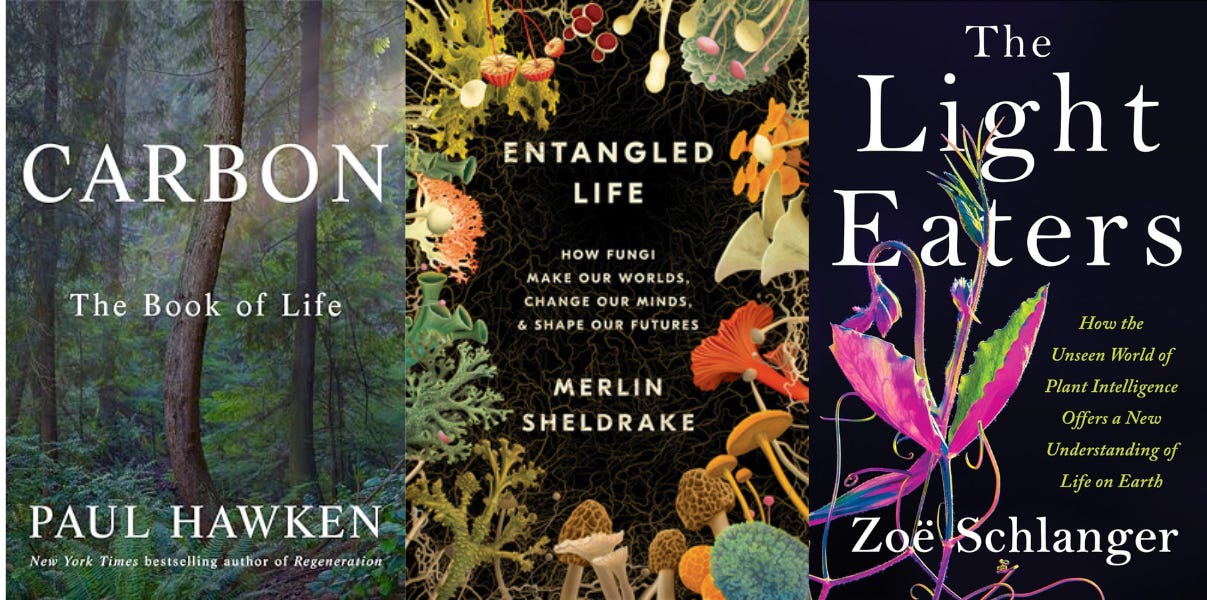
I’m in the middle of reading Paul Hawken’s Carbon, which may be one of the most elegant literary explorations of the natural world I’ve encountered in years. The book is about the carbon cycle, which sounds about as sexy as a chemistry textbook, but Hawken makes it read like an intimate biography of your favorite historical figure. The audiobook is so good that my kids actually wait in the parking lot just to hear the end of a chapter. It helps when Peter Coyote, of Ken Burns PBS documentary fame, is the narrator.
Entangled Life by Merlin Sheldrake lays out a fungal world so communicative, so relational, that the word “organism” begins to feel inadequate. I’ve shared my fascination with fungi in the past, but this book lays out example after example of just how indispensable mushrooms are, and how dependent we are on them. If you read too much into his words, you might just wonder who’s really in charge of this cosmic blue and green marble.
Then there’s Zoe Schlanger’s The Light Eaters. I thought there couldn’t be a better book on botany than Peter Wohlleben’s The Hidden Life of Trees. After reading that book, I walked into the backyard and gave our 70-year-old Chinese Elm a big hug. Schlanger’s book goes even further to suggest plants are conscious. Despite no central nervous system, they seem to see, think, and feel. They also have five times the genetic complexity of humans, and have been around for a billion years longer. This one’s a good read, and not just because it has one of the best book titles ever.
And, of course, Michael Pollan’s newest book, A World Appears just came out Tuesday. I haven’t read it yet, but I’m sure it will illuminate even more of his recent fascination with human consciousness. Pollan’s previous explorations of the human mind did not disappoint. If plant awareness feels like a stretch, Pollan is often the bridge to new perspectives.
Meet the Seasonal Table
On March 16th at 10am PT/1pm ET, I’m co-hosting with Nicki Sizemore the very first installment of The Seasonal Table — a quarterly Substack Live series marking the four seasonal turning points of the year (Spring, Summer, Fall, Winter).
For our spring conversation, Nicki and I will share what the season means to us — in nature, in the body, in the kitchen, and around the family table.
And, of course, there will be food. Nicki will demo a simple spring granola. I’ll make a French omelette, and we’ll reflect on how to plant life’s seeds for the months ahead. I hope you join us.
Stay Connected
Follow along on YouTube, Instagram and TikTok for video content, reels, and behind-the-scenes thoughts. I’m also on Facebook and LinkedIn.
Say hi on Substack Notes—I’m posting almost every day about my random reflections on life.
Join me in Chat. It’s a space just for subscribers, kind of like a group text but less embarrassing. Download the app, tap the Chat icon (it looks like two speech bubbles at the bottom), and find the latest “Enlightened Omnivore” thread.

Ahh!! This is so beautiful. It inspired me to eat breakfast outside today and see everything in my backyard so differently. Collaboration, cycle, reciprocity.
Entangled Life is my favorite non-fiction book. I continue to give it as gifts to my friends. Sheldrake laid out such a beautiful case for symbiosis. It changed how I view all living things.